

On Sundays, Papa drops by in between his errands.
He never calls first. We’d be insulted if he did.
He doesn’t stay long—ten minutes, fifteen tops—but he always brings food. In summer, tomatoes or cucumbers fresh from his garden. In winter, it’s something warm in his hands—soup, usually—and he comes in long enough to swap containers, say hello, and check on whatever practical matter needs checking.
He talks with my husband, his eldest son, about a project or paperwork, or needing to borrow a tool—something solid and substantial. A question answered. A note made.
They are affectionate without being demonstrative.
The showing up is the love.
One cold morning in early January, Papa brings pasta fagioli—my favorite—still steaming in a plastic container, its lid cloudy from heat. He warns me that this batch might be a little spicy. He is a man who can eat Carolina Reaper peppers, so I hesitate, but I’m fighting off a head cold, and spicy soup sounds like just the thing.
I tell him so.
I rummage in our fridge and trade Papa a batch of pea soup, thick and smoky from the ham we saved from Christmas. The exchange is simple. No fuss. Efficient. His way.
There is candy in Papa’s coat pocket, as always—a small, forbidden treasure he slips into my children’s palms before the momentum of our household—kids, dogs, noise, motion—overwhelms his senses and sends him back out to finish his errands, the honey-do list from my mother-in-law waiting to be completed.
They think I don’t see the contraband candy trade hands. I do, of course. I am their mother, and “I see everything,” I tease them.
But I want my children to remember Papa’s candy the way I remember my Nanny slipping me Lifesavers—quietly, conspiratorially, as if sweetness were a secret passed hand to hand.
Angus—Gus Gus to anyone who loves him—is on the floor underfoot near where Papa sits at our kitchen table, laughing at his toy dinosaurs, bulldozing a tower of blocks with great enthusiasm.
Build.
Crash.
Build again.
He is three, and therefore a contradiction. One minute he’s fiercely independent—I do it myself—and the next he’s tugging at my sleeve, pleading, Mama, nugggle me. Gus’s dimpled hand still cups my cheek when I hold him. He is cherubic when he sleeps.
And yet, he wants to run with his big brothers, to keep up, to matter.
He is the youngest child.
On the wall near the kitchen table, our digital calendar flips through photos from the past summer. Beach days. Backyard evenings. The children blonder and browner all at once.
The winter light streams through the window and catches Gus’s yellow hair just right, turning it into sunshine itself—bright, unmistakable, as if he is lit from within.
I ask Papa if his hair was that light when he was little.
“Yes,” he says. “Though I always had a crewcut,” he adds.
His hair was never curly like Gus’s. But in the summers, it turned bright blond—almost white.
As Papa tells me this, my oldest son zooms into the kitchen. He is barefoot, one earbud neatly tucked in as he talks to a friend on FaceTime. He is looking for his fifth meal of the day.
It is 10 a.m.
This past year, he has grown tall. His shoulders have broadened, his voice has deepened, and his once-light blond hair has darkened to a deep caramel. He is not quite blond anymore.
With his head half in the refrigerator, he surveys the scene, clocks Gus’s glowing head, and announces—more to the room than to anyone in particular—that “genetic inheritance is fundamentally unjust.” He mutters something about the “indignities of aging” without a trace of irony before disappearing back into The Cave, the room formerly known as his bedroom.
Papa smiles knowingly at me, then comments that his own hair did what our six-year-old Graham’s does in the summer, when it turns so light he becomes even easier to spot in a crowd—like a small exclamation point bobbing among taller bodies and darker heads.
“My Aunt Kitty used to rub peroxide in my hair,” he says. “After church on Sundays,” he adds, noticing my bewildered expression.
It sounds like he’s remembering it as he says it, the sentence arriving fully formed only at the last second.
“Who is Aunt Kitty?” I ask. I’ve been around a long time and never heard her mentioned.
“My mother’s father’s sister,” he says. His great-aunt. A Fitzgerald woman who never married. Kitty was what everyone called her. He doesn’t know what it was short for, or maybe he’s never thought about it. To him, she was just Aunt Kitty.
I squint and try to conjure a vision of child Papa in his Sunday suit having his hair lightened by a wizened old woman, and try not to laugh.
I joke about the Sun-In craze during the summers when my husband and I were teenagers—right when I first met Papa—and how my brunette friends always ended up with orange streaks instead of the “sun-kissed” glow the bottle promised.
I ask if the peroxide ever did that to him.
“No,” he says. “It just made my hair even lighter. Like the warm glow of a lightbulb.”
Papa chuckles as the memory takes shape, as if surprised by its return. He looks again at Gus, watching him knock his tower down once more.
Papa was the youngest, too.
It is the summer of 1959, and Papa is five going on six.
His oldest brother, Dick, is seventeen years older—already grown, married, or nearly so by the time Papa is born. Joe isn’t far behind. Steven comes later, but at nine years older than Papa, it’s enough to make his brothers men before he’s even in his teens.
But on Sundays, they all come back home. And Sundays always begin with church.
When Papa steps out with his family onto Whittier Avenue to walk to Our Lady of Victory for Mass, the stores may be closed because it’s Sunday, but the town is awake.
Lee’s Drugs is dark behind glass, its familiar sign promising fountain sodas and root beer floats to come. He walks past the hardware store where his father gets the lawn mower fixed; the window is perfect and still, bottles lined up from the night before, boxes squared, bunting proudly displayed.
Papa glances at the Cape Cods and colonials at his shoulder, clipped hedges and porch flags in neat rows, longing to run through the sprinklers ticking across square green lawns like they’re keeping time. The sidewalk is warm beneath his shoes, holding yesterday’s heat—the kind that settles into places built on routine.
Floral Park is a picture-perfect pocket of postwar Americana. From Papa’s vantage, this world is permanent. Safe. It is a place that believes, quietly and with confidence, that things won’t just stay the same—they’ll keep getting better.
That assumption settles in deep, like humidity expanding into the bones of an old house, and stays with him long after he’s grown enough to see how fragile it all really was.
Meanwhile, Papa’s suit is a scratchy wool prison, hot and too stiff to move in the shoulders. His shirt is buttoned all the way to his throat, the collar pressing in as a reminder that comfort is not the point. Even though the church is less than a mile away, the walk feels endless.
The suspenders of his short pants dig into his shoulders. His clip-on tie never sits quite straight, prompting countless female relatives to try to square it. His socks itch and won’t stay up. His feet swell inside his hard, shiny shoes so stiff they squeak when he walks.
Inside, the church is heavy with brick and permanence—cool inside at first but stifling once the doors close. It smells of incense and wax and old wood and perfume and warm bodies. The scent is sweet and stale and serious.
In the pew, Papa’s feet don’t reach the floor. His legs dangle and swing, knocking loudly against the row in front of him. Anyone within reach scolds him, relative or not.
Monsignor Irwin drones on in a jumbled tongue about patience. Or tending things. Words meant for adults, his mother, Betty, tells him.
Papa doesn’t understand a word of the Mass, but he knows what to do.
When to sit.
When to stand.
When to answer back—Et coom spirit-oo too-oh—perfectly, without knowing why.
To keep himself entertained, Papa counts hats. The uglier the better.
Easter bonnets with stiff silk flowers.
Small veiled hats pinned into tight curls.
Wide brims meant for drama; narrow ones for obedience.
Hats with lopsided bows, feathers that look like they escaped a bird mid-flight. Hats pinned with fake fruit.
Hats bristling with netting that cast stained-glass shadows across powdered faces.
His favorites are the ones that look like they might topple if the wearer sneezes.
In church, everyone is rigid. Backs straight. Gloves buttoned. Hymnals opened. Everything in its place. No one doubts that next Sunday will look much the same. This world believes repetition is proof of success.
Papa counts the minutes not to heaven but to freedom.
The best part of church is when Monsignor chants Ee-tay miss-uh est; Papa doesn’t know what the words mean, only that when they’re said, he is free, and Sunday really begins.
He walks faster on the way home. Not even the draw of watching the railroad crossing gates go up and down slows him.
At home, everything loosens. There is a collective sigh as hats come off first, pins pulled free with a soft click from the felt. Jackets slide from shoulders. Stiff shoes thump to the floor. Sleeves are rolled up, buttons are undone, and belts are loosened. Good clothes are folded away; simple ones tugged on, quick and careless now.
Play clothes. Bare arms. Open windows.
Outside, the men gather on the stoop or stand along the edge of the lawn. These men from the Bronx, with family still in Brooklyn, are now pioneers in the suburbs. They are surrounded by the sounds of Sunday. The reassuring hum of Jericho Turnpike is just a few blocks away, with its cars and citizens moving along to the sound of American progress. Lawn mowers buzz and children laugh as they whiz past on their bikes. Dogs give chase.
The men smell of cigarettes and Brylcreem. Joe smells of Old Spice. Papa hovers at the edge of the circle, listening for talk that’s interesting.
One man taps the back of the Daily News like evidence, pointing accusingly at the box score with a nicotine-stained finger. Seven-nothing yesterday to the Senators, and shut out again this morning in the opener. The Yankees stink this year.
Someone mentions Alaska and Hawaii becoming states, adding stars to the flag.
Another man grumbles about the Russians.
Someone notices Papa hovering when the talk shifts.
“Go on. Scram. Inside.”
At five, he flits easily between the men and the women, hovering where the talk feels scandalous, then darting off again when he’s shooed away.
Inside, the house smells warm and certain—meat roasting low and steady since morning, onions softening in fat, potatoes holding heat on the back of the stove. It smells of patience and planning, of a meal that was started hours before anyone put on coats and ties.
Betty cooks as if she’s expecting more people than exist. There are vegetables everywhere. Mashed potatoes, baked potatoes, potatoes au gratin. Everyone gets what they like.
“She made eighty-seven vegetables,” Papa jokes.
While they wait for dinner, Papa plays in the den, running metal toy cars along the rug’s edge, crashing them into chair legs, lining them up just to knock them down again. Sometimes he plays with plastic soldiers. Sometimes Lincoln Logs. Sometimes, whatever his older brothers bring, indulgently, because he’s the baby.
The console radio hums with the Yankees game, punctuated by groans when Mantle or Berra blows it at the plate. The Senators are back today for the shutout. 1959 is a shit season.
“Supper’s ready!” Betty calls.
The men stub out cigarettes and lumber inside, bringing the smell of tobacco and incense in, still clinging to them in the humid air. The kitchen table is crowded with Pyrex and chipped bowls. A percolator hisses. Coffee and smoke braid into anticipation.
Sunday dinner follows Mass at roughly the same hour every week. Everyone arrives hungry, as if the whole week has been leading up to this meal. There is a grown-ups’ table and a kids’ table, and everyone knows without being told that you do not refuse seconds.
Betty’s door is always open—to people, to animals, to stray souls of every kind. Less a short-order cook than someone determined to love through feeding. Vegetables of every kind are multiplied, and custom orders are taken and prepared with love, so no one feels overlooked. Care, applied consistently, is a way to hold people together. Betty feeds whoever shows up: the weekly regulars, plus visitors and their friends. Aunt Kitty comes every week.
Better still, she stays the night on Sundays.
If the weather is nice, she walks over from her house, just a few blocks away. Otherwise, Papa’s father picks her up so her cotton dress won’t wrinkle in the heat.
Papa prays for rain. He likes it when they pick her up in the car. Aunt Kitty always makes room for him beside her without a word, and he sits on her lap in the front seat, watching the world go by.
Aunt Kitty is old. That’s all he really knows. Older than his mother. Older than the house. Older than the President, probably.
She is warm and solid, her body a safe enclosure. Squishy but strong. Gentle with him in a way that feels intentional.
When Aunt Kitty first arrives, she sets her pocketbook upright on the same chair every week. Papa notices because no one ever moves it. No one would dare. It’s part of the ritual.
Most weeks, she pulls a paper sack of cookies from Tulip Bake Shop on Tulip Avenue from her purse, grease spots blooming through the parchment paper where the butter has soaked through. He knows there are other wonders in that handbag yet to come.
Her copper hair is shellacked into careful waves, pinned and sprayed into submission. She smells of soap and lavender, and something sharper than his mother. Aunt Kitty carries herself with a confidence that feels ancient, something she’s brought with her from the Bronx and set down deliberately on a quieter street on Long Island.
Aunt Kitty has no children of her own, leaving her free to claim everyone else’s youngest. Papa is her favorite.
After dinner is cleared, Kitty pats the stool beside her. Papa knows exactly what to do.
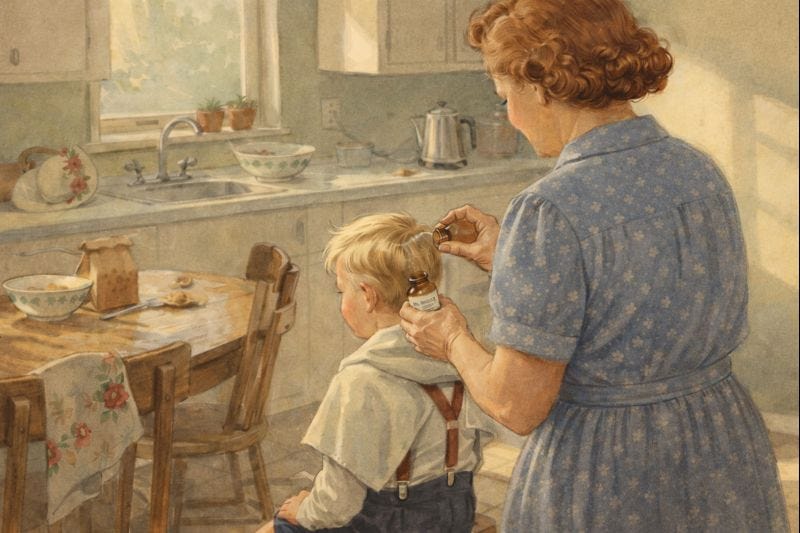
She opens her pocketbook again and takes out a small amber bottle, thick glass, a medicinal label, no-nonsense. He stands between her knees while she drapes a towel over his shoulders, warm against his neck.
The smell comes first—sharp and clean. It wrinkles his nose, reminds him of skinned knees and bathroom tiles and, now, Sunday afternoons.
Aunt Kitty pours a little into her palm. It fizzles faintly when it touches his hair. She rubs it in carefully, combing it through with patience, as if this is all that matters in the world.
No one stops her. No one comments. The ritual folds into the afternoon the way dessert will come later, the way dusk will arrive, whether anyone notices or not.
When she finishes, she pats Papa’s head once, satisfied.
While his mother cooks for everyone, Kitty tends to him. One kind of love multiplies; the other focuses. Maybe that’s why he remembers it. Maybe that’s why it mattered.
Papa never thinks to ask why. It doesn’t seem strange to him then. Maybe not until much later. Maybe not until now.
He laughs softly as he tells me, realizing only in retrospect how odd it sounds.
“That was my family,” he shrugs.
He doesn’t remember all the details; it’s a blur of Sundays run together. It’s hard to remember ordinary days when you only realize later they were extraordinary.
Sixty-plus years later, there is no regular church, no ritualized family dinners—just soup, candy, and a few minutes carved out between errands. Still love. Still feeding. Still connected.
Papa finishes his visit the way he always does. He bends to make Gus laugh once more, calls out “See ya when I see ya,” and heads out.
Errands are calling.
As he gets older, he moves more slowly. There is weight now. Discomfort. Loss. But when he remembers to, he takes pleasure in the little ones—in their silliness, their joy—and in the fact that he has done something right to be blessed with small people who see the world with new eyes.
He doesn’t have words for it; only this: once the thing is finished and the words are said, you’re allowed to let go.
Ee-tay miss-uh est.
Mass has ended. Go in peace.
After he leaves, I write it all down.
Often with Papa, these stories slip out by accident. I’ve learned to pay attention when they do. To ask questions. To recognize when I’m being let in.
Why did Aunt Kitty rub peroxide into his hair?
Who knows.
She just did.
And this—right here—is the same.
It just is.
Since publishing this short story, I learned more about Papa’s family — discoveries that led to two additional companion pieces and an interview about the story.
Peroxide Sundays: A Companion Piece
Peroxide Sundays: A Tragedy on Bainbridge Street
Peroxide Sundays: An interview with GenClub
If you’ve enjoyed reading so far, please consider subscribing or supporting my work — it helps make the next discovery possible.
Author’s Note
Over Christmas, I gave myself a gift: How to Write Compelling Stories from Family History by Annette Gendler.
A few days later, my father-in-law stopped by unannounced—mid-errands, as he always does—carrying soup. In the span of ten quiet minutes, while we traded containers and my youngest knocked down a tower of blocks, he mentioned, almost offhandedly, that his Aunt Kitty used to rub peroxide into his hair on Sundays after church when he was little.
The story slipped out sideways.
Because I’d just read the book, I did two things I might not have done otherwise:
I wrote everything down immediately, before meaning or polish could overwrite memory.
I resisted the urge to explain or resolve what I didn’t yet know.
Instead, I focused on:
One small ritual
One ordinary Sunday
One five-year-old’s view of the world
This piece is historically grounded, emotionally true, and necessarily imagined in places.
I don’t know exactly what Aunt Kitty wore or why she did what she did; I don’t know if Papa counted ugly hats or if Uncle Joe smelled like Old Spice. What I do know is that this happened, and that memory often works the way this story does.
I’m sharing it as a draft on purpose, in the truest sense of the word.
If you work with family stories—your own or someone else’s—I’d love to hear:
What details helped you see the scene most clearly?
Where did you want more, or less?
What questions lingered?
And to Annette Gendler—if this ever finds its way to you—thank you. Your work helped me recognize a story while it was still happening.
Thank you for the call-out, Lauren! I'm so thrilled to hear that my book was helpful to you, and that it prompted you to immediately recognize the storytelling potential of your father-in-law's mention of his great-aunt rubbing peroxide into his hair on Sundays. What an odd but also homey tidbit, and kudos to you for turning it into an evocative story.
Loved this so much. I felt like I had jumped in time and was witnessing what you describe. Just beautiful.