

For anyone who woke up today thinking, “How is it so late already?” and now has to spend a week dragging small monsters out of bed while their body clocks rebel, this one is for you.
Roughly a hundred years after Massachusetts State Grange v. Benton, we’re still arguing about what time it is (or should be)—only now the battle is waged in WhatsApp group chats and Instagram reels instead of town halls.
The venue has changed; the complaint has not.
If you’re feeling grouchy or bleary-eyed, know you’re joining a long and glorious lineage of people who viewed Daylight Saving Time as an assault on ordinary life.
Time has always been political. The only thing that has changed is where we lodge the complaints.
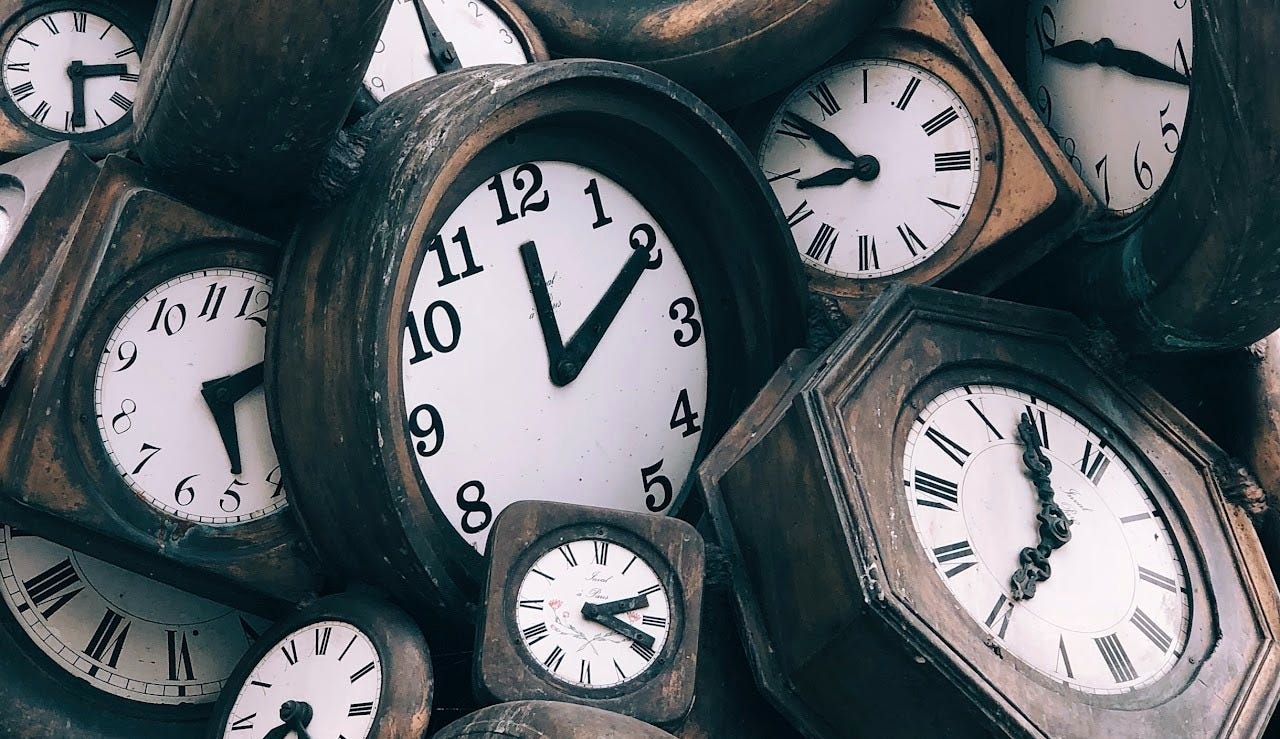
When Time Went to Court
The drama actually began as a byproduct of the Great War.
In 1918, the U.S. implemented its first national Daylight Saving mandate to conserve fuel for WWI.
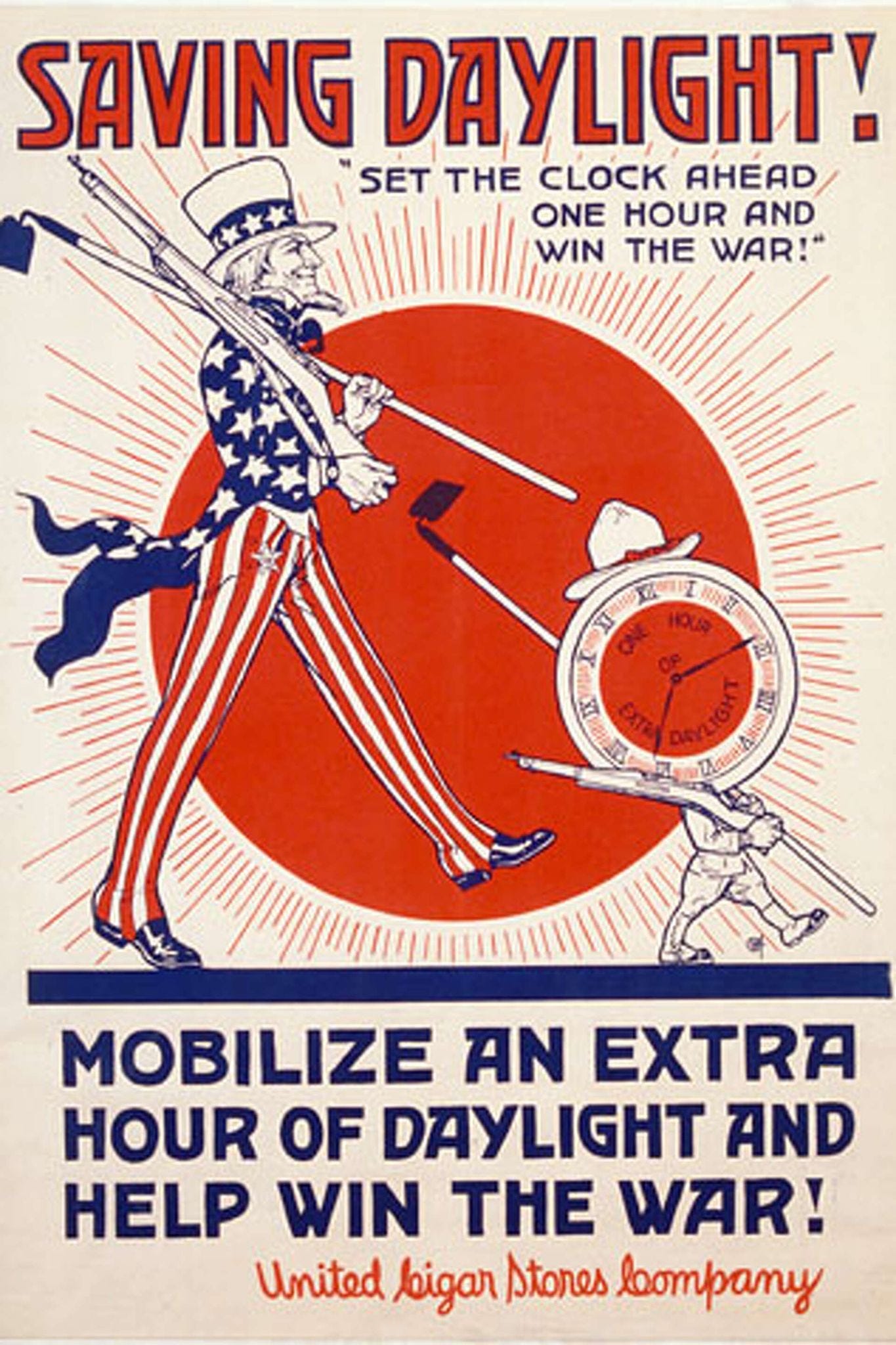
United Cigar Stores Company Advertisement, “Saving Daylight! Mobilize an Extra Hour of Daylight and Help Win the War!” ca 1918. National Museum of American History, Archives Center, Smithsonian Institution
But, it was so loathed by rural America that Congress repealed it just a year later, over President Wilson’s veto.
In 1926, the Massachusetts State Grange—joined by the Town of Hadley, the Brotherhood of Locomotive Engineers, and several others—sued to stop Massachusetts from enforcing its ‘Daylight Saving Acts,’ which pushed the clock an hour ahead for state and local purposes.
The Grange was a powerful rural advocacy organization, born in barn meetings and church basements, and they had a point: you can’t tell a cow the clock has changed.
The farmers’ complaint was not abstract. “Fast Time” scrambled milking, harvest work, and morning chores, which followed the sun and the needs of animals, not the demands of the stock exchange.
On the other side of the argument sat the urban dwellers and city retailers who loved the extra evening light for shopping and baseball. It was the ultimate clash of rhythms: bodies and barnyards versus ledgers and late‑night box scores.
One world woke with the rooster; the other with the opening bell.
Holmes’s Cool Answer to a Hot Fight
The case reached the Supreme Court later that year. Justice Oliver Wendell Holmes Jr. issued an opinion that essentially told the plaintiffs to read the statute and stop whining. Holmes held that while federal law governed federal business (like trains and post offices), individual states were free to decide what “official time” meant for their own schools, courts, and local life.
Holmes also invoked the concept of equity, in which the federal courts shouldn’t intervene unless a case involved “great and irreparable injury.” Talk to anyone who will spend the next few weeks trying to reset a toddler’s internal clock, and “irreparable injury” starts to feel less like legal doctrine and more like a diagnosis.
It’s a painfully accurate description of what will happen in households across the nation over the next few weeks, trying to get out the door on time or convincing a child that, despite the sun still shining outside, it is, in fact, bedtime.
The Chaos of Different Clocks
Holmes’s ruling cleared the path for decades of temporal anarchy.
World War II briefly reimposed “War Time”—a year-round daylight saving mandate from 1942 to 1945—but once the peace was won, the clocks went back to a localized free-for-all.
From the late 1940s through the mid-1960s, a commuter could cross a county line and lose an hour without ever leaving his train seat. States and cities treated time like a suggestion. Neighboring towns functioned like different planets sharing a single bus line.
By 1966, this patchwork was a logistical nightmare for airlines, television broadcasters, and anyone with a schedule to keep. Congress finally stepped in with the Uniform Time Act, essentially telling the nation: “Fine, we’ll do it, but we’re all doing it together.”
Or, at least, most of us.
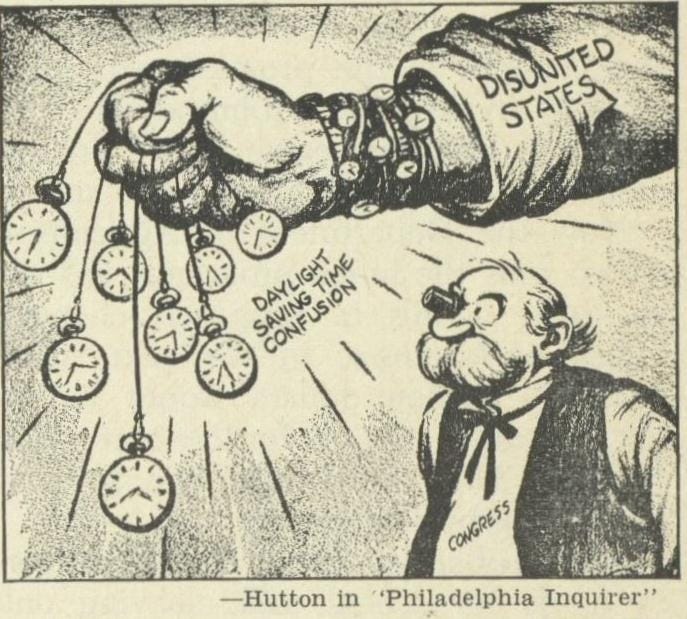
Hutton, "Disunited States," Philadelphia Inquirer, ca. 1966.
The law allowed states to opt out if they stayed on Standard Time year-round. Hawaii, with its tropical sun, saw no reason to shift. Arizona (mostly) followed suit, deciding the last thing they needed was an extra hour of blistering evening heat.
Even with federal “uniformity,” the cracks remained.
I’m reminded of the 2002 West Wing episode where staffers find themselves stranded in rural Indiana. Because of a local time-zone quirk—where some counties observed the change and others didn’t—they kept missing the presidential motorcade and the train, trapped in a loop of “what time is it here?”
Three years before iPhones were everywhere, the confused clock could still leave you standing on a platform, watching the future pull out of the station without you.
Temporal Vertigo
If you work globally, you can thank the Energy Policy Act of 2005 for a new kind of “temporal vertigo.” Pushing the U.S. start date to the second Sunday in March, the Act created a three-week window where we are out of sync with Europe and the UK. Before our digital tools could automatically convert calendars, that one stolen hour wreaked havoc on conference calls, calendars, and collective sanity.
Thank goodness our virtual calendars handle the math, because for those of us in a state of circadian whiplash that no amount of coffee can fix, outsourcing our sanity to Google Calendar is the only plan.
Years ago, when the switch wasn’t automatic, I once showed up for a meeting a full hour early and was so aggravated that everyone else was running so behind. I then very sheepishly realized they weren’t late; I was ahead.
For the first few weeks after Daylight Saving, I am scrambled. Depending on whether we’ve sprung forward (boo) or fallen back (yay), I grumble. How can an hour make such a difference?
I don’t know—but it does, and I’m not alone.
The Debate That Won’t Sleep
Despite a century of tinkering, the argument is still unresolved.
Sleep researchers overwhelmingly favor permanent standard time and warn that the twice‑yearly clock changes disrupt our circadian rhythms, with ripple effects on health and safety. Studies have linked the spring shift to higher rates of car crashes, a temporary uptick in heart attacks and strokes, and other stress on the cardiovascular system. Meanwhile, tourism and business groups keep lobbying for permanent DST, arguing for “longer” evenings—more time to spend money in the light.
We are still fighting the same battle the Grange fought 100 years ago: do we prioritize the biology of sleep or the economy of light? Who should win—the body clock or the cash register?
As usual, our hearts vote one way, and our wallets vote another.
The 23‑Hour Day
Modern science confirms what every parent knows: shifting the clock can turn an easygoing child (or adult) into a small, furious time‑zone refugee. These biannual changes introduce a misalignment between our social and biological clocks.
Clinical data show that for infants and toddlers, the ‘spring forward’ isn’t a one-night loss, but can take up to a month to recover. For the youngest among us, the law of the clock takes weeks to catch up to the law of the body. The grievances are measurable; you aren’t imagining it.
Sleep labs have charts for the tantrums you see playing out in your house.
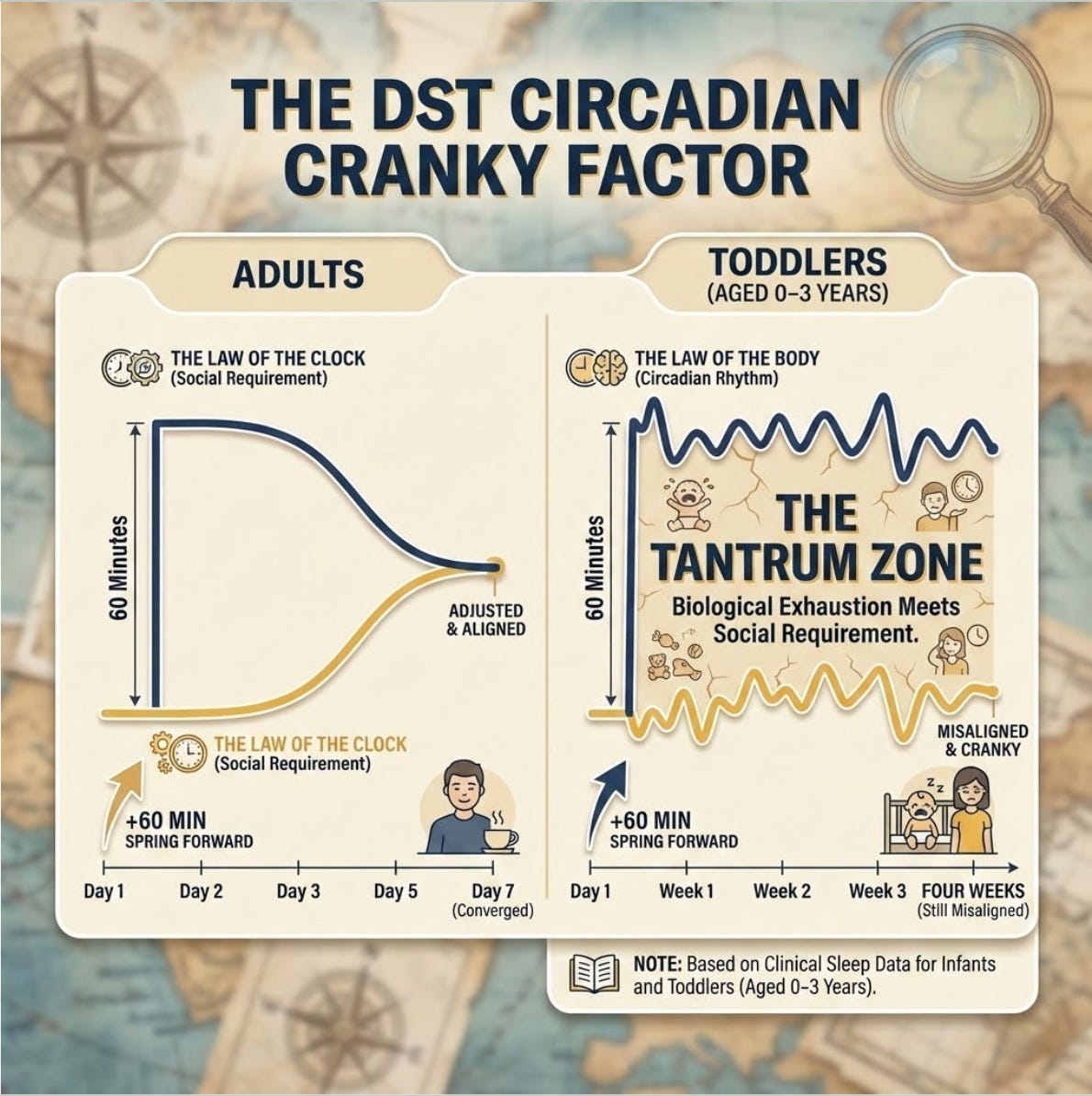
AI-generated image to capture the author’s circadian disruption “crankies.”
A Line from Them to You
So, when you stand in your hallway Monday morning, coaxing a bleary‑eyed child toward breakfast and socks, know that you’re participating in a century‑long dance that shaped our ancestors’ days, too.
One hundred years ago, citizens of the United States waited for the Supreme Court to decide whether states could legally move the hands of the clock; today, Congress is still debating whether those hands should ever move back.
In the archives, I spend most of my time trying to find the hours my ancestors spent that have been lost to silence.
Tomorrow, I’ll just be trying to find the hour I lost to the law.
We are all witnesses to this ongoing trial of time—coffee in hand, waiting for the sun to catch up to the clock.
Further Reading and Sources
Standard Time Act of 1918 and the repeal of national Daylight Saving Time in 1919.
Energy Policy Act of 2005 – DST extension to the second Sunday in March / first Sunday in November; technical explainer.
Downing, Michael. “One Hundred Years Later, the Madness of Daylight Saving Time Endures.” Smithsonian Magazine, 9 Mar. 2018.
Waxman, Olivia B. “The Real Reason Why Daylight Saving Time Is a Thing.” Time, 3 Nov. 2016.
Gould, Zachary. “Let There Be Light: Who Gets to Play God with Our Daylight?” Hofstra Law Review, vol. 48, no. 4, 2020, pp. 995–1033.
Shughart II, William F. “Daylight Saving Time: Ditch the Switch and Stop the Irrational Time‑Change Regime.” The Independent Institute, 6 Mar. 2020.
Waxman, Olivia B. “Why Does Daylight Saving Time Start at 2 A.M.?” Time, 8 Mar. 2019.
Kaplan, Sarah. “Daylight Saving Time Solved U.S. Clock Craziness with the Uniform Time Act.” The Washington Post, 16 Mar. 2022.
Dockrill, Peter. “The Reason Daylight Saving Time Begins (and Ends) at 2 A.M.” Mental Floss, 26 Oct. 2025.
Nice history of dayllight saving time.
An interesting article @Lauren Macquire!
It sent me off looking at the history of Daylight Saving in New Zealand.
According to a NZ Government website (https://www.govt.nz/browse/recreation-and-the-environment/daylight-saving/history-of-daylight-saving-in-nz/), the history in this country can be summarised as follows:
1868 — New Zealand officially set a national standard time — called New Zealand Mean Time — at 11 hours and 30 minutes ahead of Greenwich Mean Time (GMT).
1927 — New Zealand first observed daylight saving time. The dates and time difference were changed several times over the following years.
1941 — New Zealand summer time was extended by emergency regulations to cover the whole year.
1946 — New Zealand summer time (12 hours in advance of GMT) was adopted as New Zealand standard time. Daylight saving time was effectively discontinued at this point.
1974–5 — Daylight saving was trialed again in 1974, and introduced in 1975. Daylight saving time is 1 hour ahead of New Zealand standard time.standard time (NZST)
1985 — Public attitudes were surveyed and over the next few years the period of daylight saving time was extended twice.
2006-07 — Following public debate and a petition presented to Parliament the period of daylight saving was extended to its current dates. New Zealand observes daylight saving from the last Sunday in September to the first Sunday in April.
2008 — Daylight saving public attitude survey.
[Now I want to know what the outcome of the public survey was?)
So, we currently have half the year (April-September) as Standard Time (NZST) and half the year (Oct-March) as Daylight Savings Time (NZDT). We next change clocks - back an hour on April 5th.
I have always found it reasonably easy to adjust but I appreciate it can be very problematic for some people.