
✨ When the Archives Go Dark ✨
How a single 3×5 card — and a government shutdown — paused a century-old search for truth

The Request
Early yesterday, I sent a research request to the National Archives about injuries my great-grandfather sustained on October 15, 1918, during the Meuse-Argonne Offensive in World War I.
The battle, fought from September 26 to November 11, 1918, was the largest and deadliest campaign ever fought by the U.S. Army—a brutal 47-day push through the dense forests and ravines of northeastern France that helped bring the First World War to an end.
More than 1.2 million Americans took part in the offensive, advancing across a thirty-mile-wide front under relentless machine gun fire and mustard gas. In just seven weeks, 26,000 were killed and 95,000 wounded.


American troops in the Argonne Forest, Fall 1918.
A Downgraded Injury: From Severely to Moderately Wounded
I wanted help locating a single 3×5 index card that might answer a century-old question: why were my great-grandfather’s wounds, initially listed in military records and contemporaneous newspaper reports as “severe,” later downgraded to “moderate?”
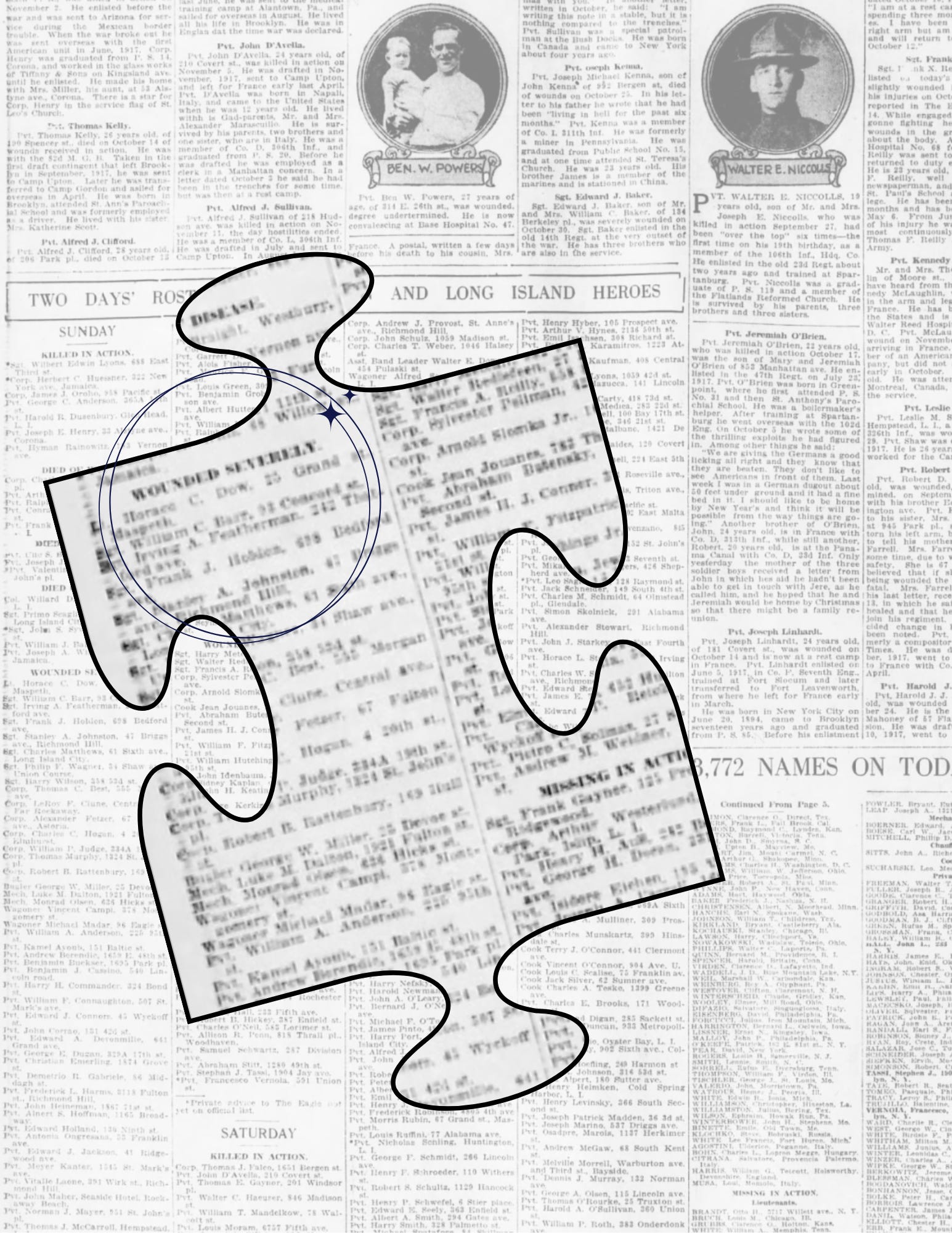
“Brooklyn and Long Island Heroes Whose Names Are on the Casualty List,”
Brooklyn Daily Eagle, December 15, 1918, p. 64.My great-grandfather’s name is among those listed as severely wounded.
These cards are part of a record group titled “Name File of Dead and Severely Wounded Casualties of Infantry Divisions in the AEF,” and were created by the U.S. Army during World War I.
During the war, army clerks created tens of thousands of these cards—filed by division and regiment—to cable casualty reports home. On each one-sided 3×5 card, some handwritten, others typed, the war was reduced to clerical shorthand: a soldier’s name, rank, regiment, and the extent of his wounds—“severely,” “moderately,” or “slightly.”
Below are examples of the index cards I’m hoping to locate.
Each card captures, in clerical shorthand, the cost of war reduced to a word.
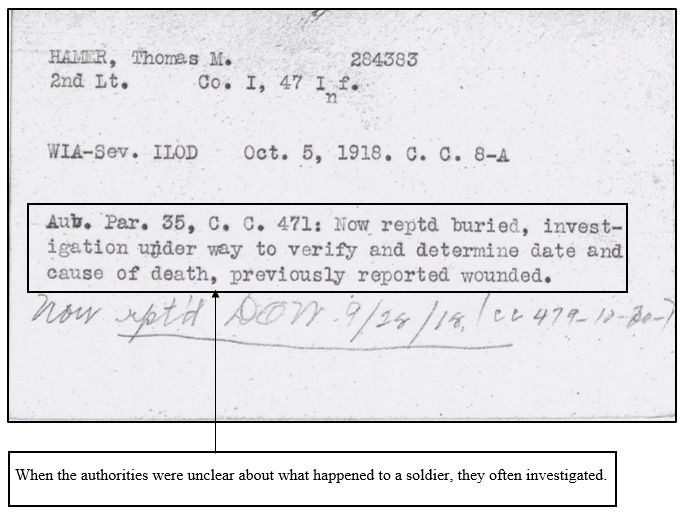
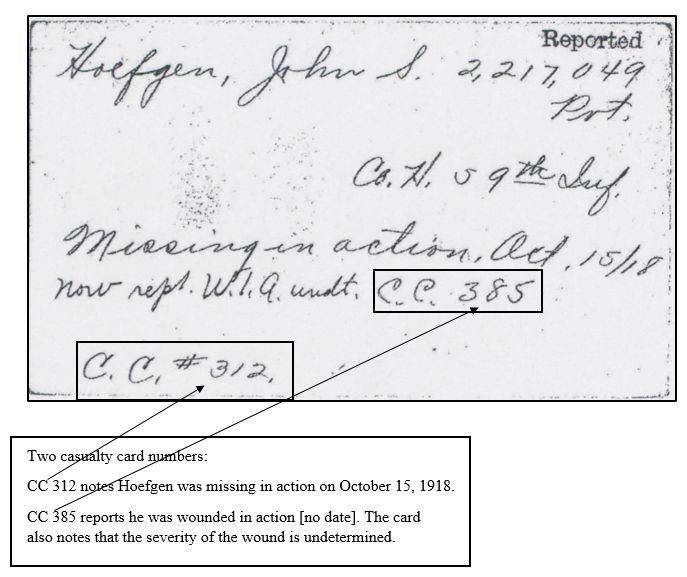
U.S. Army casualty cards from WWI documenting a soldier’s wounds.
Courtesy of “Name File of Dead and of Severely Wounded Casualties of Infantry Divisions in the AEF, 1918” by Constance Potter
The Mystery
One of those cards may hold the answer to a question that’s been on my mind. My great-grandfather was wounded in one of the fiercest battles the U.S. Army ever fought, just weeks before the Armistice that ended “the war to end all wars.”
So why was the degree of his injury downgraded?
Did he recover better than expected?
Did someone reclassify his wound for bureaucratic reasons—perhaps affecting his pension or standing among veterans?
What did “moderate” even mean in the language of 1918 medicine and morale?
The Shutdown
I wrote to the Archives hoping for a copy of that card. Within minutes, an automated reply appeared in my inbox:
“The National Archives and Records Administration is currently closed to normal operations due to a lapse in appropriations…”
In other words, the archives are dark. The past, for now, remains locked behind a door, and my questions will have to wait.
It’s easy to think of a government shutdown in terms of politics, but it also halts quieter forms of public service—the preservation of memory itself.
Archivists, historians, and specialists protect the raw material of truth in the form of documents that tell us who we are, where we came from, and how our institutions evolved.
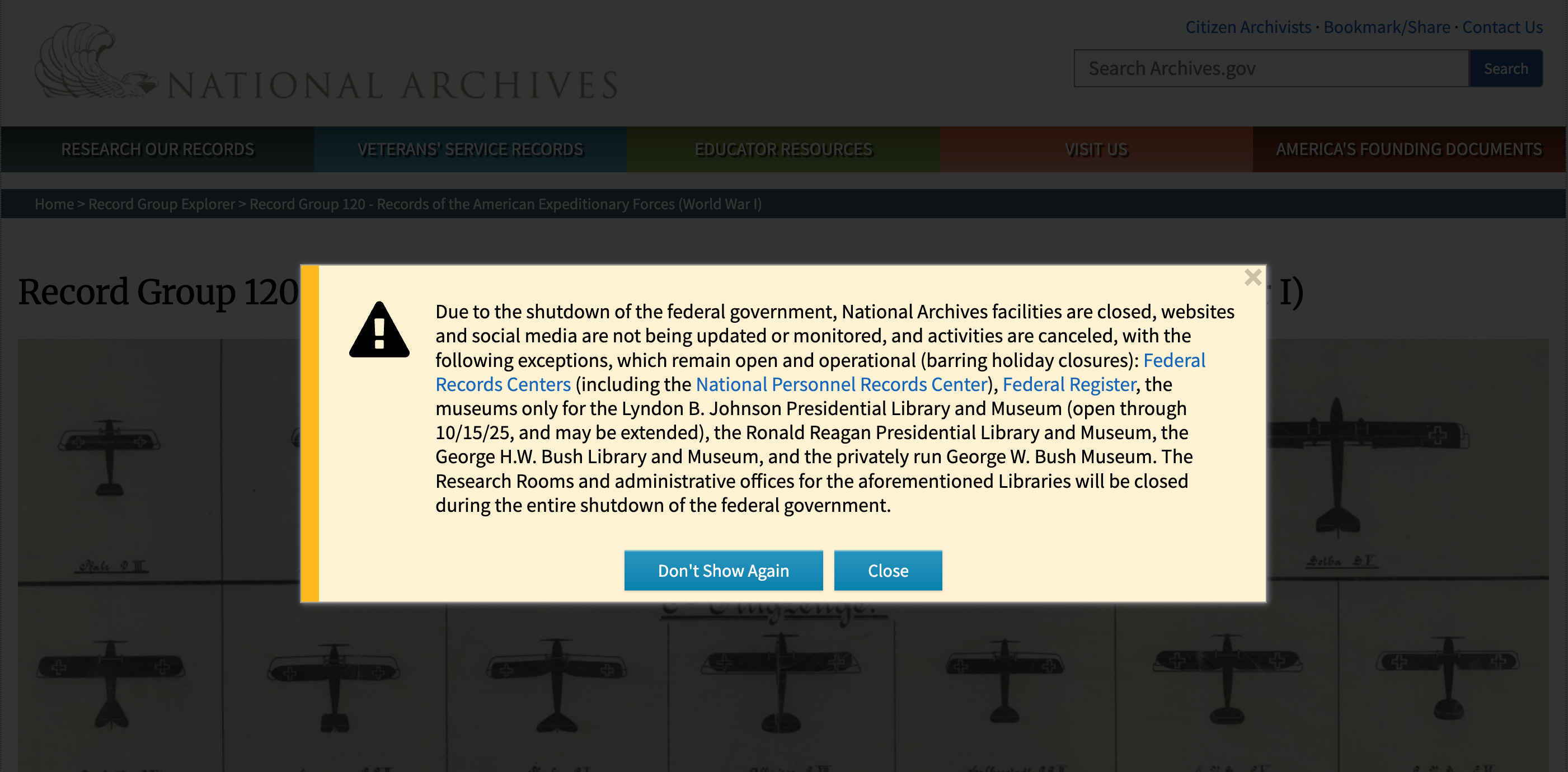
Federal websites currently display closure notices during funding lapses.
For now, the archivists’ desks—and history itself—stand still.
Preserving Fragile Truths
When the archives go dark, history waits.
Birth certificates, immigration manifests, military records, pension files, war casualty cards—all of it waits in the dark until the lights come back on.
For genealogists and historians, this is more than an inconvenience; it’s a reminder of how fragile access to truth can be.
Every discovery we make depends on the infrastructure that preserves it—climate-controlled vaults, open databases, metadata systems, and the archivists who know how to navigate them.
The Bridge Between Worlds
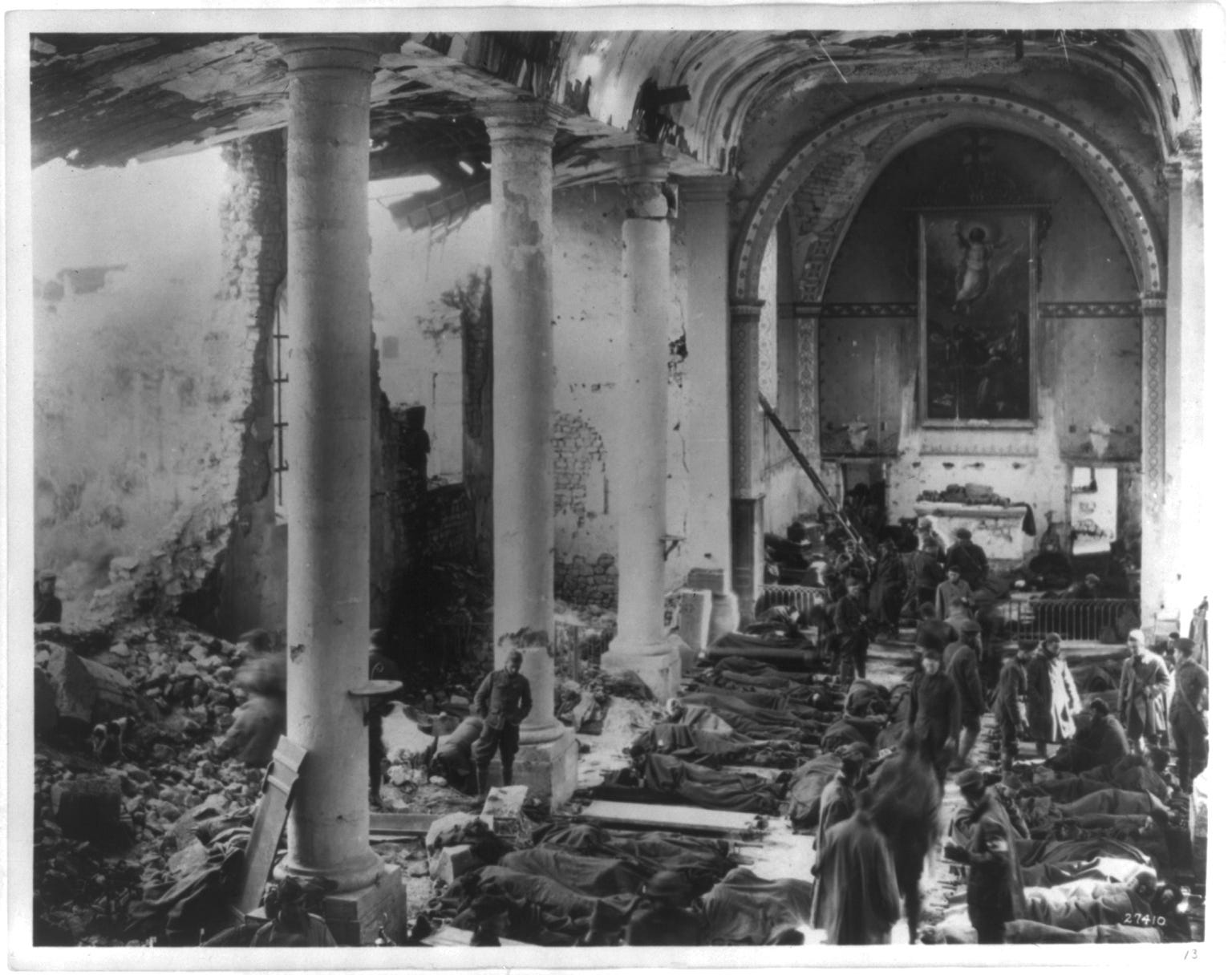
American Army field hospital inside ruins of church in France, 1918. Perhaps my great-grandfather was here.
More than repositories, these institutions and the records they preserve are the connective tissue between generations. Each of the fragile 3×5 index cards is a record of an American’s survival, suffering, or sacrifice.
For me, the records are the only bridge between the living and the dead—between silence and knowing.
The Return
Today marks 106 years since my great-grandfather sustained what the Army first called “severe” wounds, somewhere in the war-ravaged ravines of the Argonne forest.
The current government shutdown is devastating in many urgent, visible ways—but it also reaches quietly into places most people never think about, imperiling the work of preserving history itself. On the anniversary of his injury, I find myself unable to access the very records that document it.
When the doors reopen, I’ll send my request again. Until then, I’ll keep following the trail. Because even when the archives are closed, the search never really stops.
Somewhere in the National Archives, the card that recorded my great-grandfather’s injuries is waiting to be found.
And with it is a story yet to be told.
What Comes Next
This essay marks the beginning of a broader project exploring my great-grandfather’s service in the 165th Infantry Regiment—formerly the legendary “Fighting 69th” of the 42nd “Rainbow” Division.
The regiment’s history stretches from the Irish-American volunteers of the Civil War through the muddy trenches of World War I, where it fought at Champagne, Château-Thierry, St. Mihiel, and the Meuse-Argonne Offensive.
In the months ahead, I’ll be tracing the battles that shaped these men’s lives—following the 165th’s path through France, examining the records they left behind, and exploring how the echo of war carries through generations.
Subscribe below to follow this series and receive upcoming essays on the 165th Infantry, the Meuse-Argonne Offensive, and the search for the soldiers who carried its colors.
📚 Further Reading & Context
On the Meuse-Argonne Offensive & the American Expeditionary Forces:
Yanks: The Epic Story of the American Army in World War I – John S. D. Eisenhower
Over the Top: A Doughboy’s Story of the Great War – Arthur Guy Empey
On the 165th Infantry aka the “Fighting 69th:”
Primary Sources & Online Collections:
#archives #publicservice #history #familyhistory #genealogy #research #WWI #MeuseArgonne #archivesmatter #NARA #theheirloomdetective #lulumackenzieofthearchives