

Where Every Ghost Knows Your Name
On a haunted restaurant, a Prohibition tunnel, and the Emily Dickinson song that followed me home in a lightning storm.

What are family historians if not ghost hunters?
We spend our days trying to trace people who have disappeared, listening for the echoes everyone else walks past. Genealogy is a séance you conduct alone.
This is what I found myself thinking about last night, over dinner at Lucky Bones Backwater Grille in Cape May. The restaurant sits along Route 109, and locals acknowledge it is haunted, although "haunted" has always felt slightly derogatory to me; it is the wrong register entirely.
What Cape May has, and what Lucky Bones has in particular, is more like an undercurrent. A hum. An energy running beneath the ordinary, which you can feel if you are still enough, for long enough, to notice.
I first started coming to Cape May in 2016, and that undercurrent was one of the first things I fell in love with. The sense that whatever had happened here had not entirely finished. That whoever had been here had not quite left. It is a strange thing to try to explain to people who have not felt it, and a wholly unnecessary thing to explain to those who have.
The Ghosts on Shift
A summer storm was rolling in low as we pulled into the parking lot. Inside, it was not yet six o’clock, but the room was already packed — full of the choreographed hum of a place that never quite stops. I took this as a good sign. I was there with seven other people, including two wiggly kids and one particularly ornery three-year-old, which meant I could only take in the room’s energy in brief snatches.
But I noticed. It was there.
As I checked our party in, I spoke with Jason, the closing manager for the evening, who answered my questions with the calm of a man who has been asked about the ghosts a thousand times.
“Yes,” he said. “The place is haunted.” Alone in the building, people mostly hear footsteps overhead. Weird things happen in the office.
I asked if the spirits were friendly.
He paused. “Not exactly. But not menacing either. More… territorial.”
I asked if I might take a quick peek upstairs, where the loudest activity is reported. He smiled and shook his head — no non-employees allowed up top.
Fair enough. But then he kept talking, and mentioned what lies beneath the building. Tunnels. Partially caved in, but still navigable. Carved out during Prohibition, to run rum right in from the water.
I told him I was a writer and that I’d love to come back off-hours, even for a few minutes, if it were ever possible. He suggested I email, which I did on the spot, drafting it as I stood out of the way of the crowded entryway with the cranky three-year-old on my hip, waiting for our table.
What Lies Beneath
Lucky Bones has been serving seafood and brick-oven pizza for two decades now, but the prevailing wisdom in town is that the spirits occupying the place have been here much longer — and have zero intention of going anywhere.
Long before the current dining room was built, this stretch of Schellenger’s Landing was home to something darker and more interesting. According to H.L. Williams’s memoir in Cape May Magazine, the building was known in the 1930s as The Anchorage, run by the Wallace family, back when Route 109 was still a drawbridge, and the canal had not yet been cut.
The Wallaces did not start at Schellenger’s Landing. In the 1915 New Jersey state census, George Henry Wallace — Canadian-born, thirty-one, a blacksmith — was living in Camden with his Irish-born wife Nora and their small children, including a six-year-old boy named George Henry Wallace after his father.
Somewhere between the forge and the shore, this family reinvented itself.
By May of 1933, that six-year-old was twenty-four, and had married an Irish-Catholic girl from Camden named Marie Bridget Doran. The wedding announcement ran in the Camden Evening Courier on May 4 under the headline “Marie Doran Bride In Wedding Today,” resplendent with details about her white satin gown made en train, her tulle veil falling from a cap of lace, and the calla lilies she held during the reception at the Silver Lake Inn. Seven months later, on December 5, 1933, the Twenty-First Amendment was ratified, and national Prohibition ended.
Whatever the Wallaces had been doing at Schellenger’s Landing up to that point — and the tunnels beneath the building certainly paint a picture — they were now, legally, in the bar business.
In June of 1942, Nora M. Wallace applied for the Plenary Retail Consumption License at “the Anchorage, Third Ave., Route 4, Township of Lower” in her own name. A few months later, in a legal notice printed in the Cape May Star and Wave, she transferred it to her son, George Wallace Jr., trading as The Anchorage, at the same address. The paper trail is small and specific because the new liquor laws forced it to be, but it’s part of what makes a family historian sit up straight.
The liquor license had been in Nora’s name.
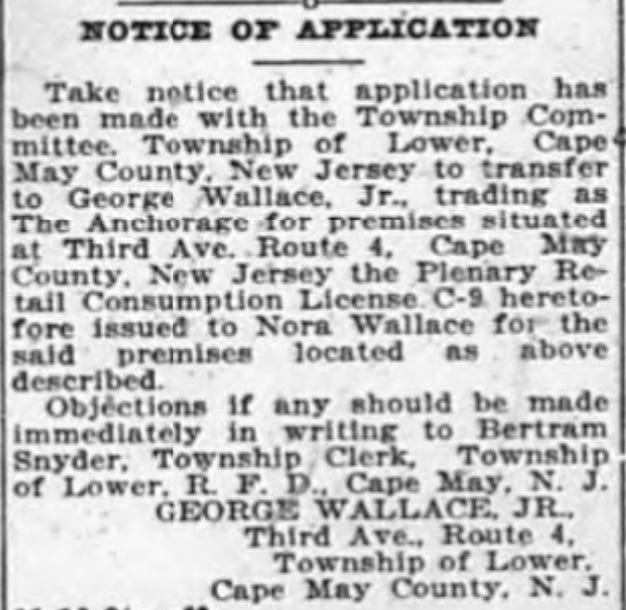
Eight years after that, the 1950 census shows Nora, then sixty-five, still living above the saloon with her husband George, no longer able to work — and with their son George, now forty and running the place, George Jr.’s wife Marie, and their four children, including an eleven-year-old George of the third generation.
Three Georges under one Schellenger’s Landing roof. A saloon, a family, a name that endured, like the ghosts in the building.
George Sr. died on November 6, 1954, at seventy-two, and is buried in Cape May. The family stayed in the restaurant business for another two generations at least. In a 1985 Cape May County Herald profile of the Wallaces then running the local Bonanza, a family member recalled that “a great-grandmother had the first seafood restaurant in Cape May, and the family originally owned the Anchorage Cafe there.” Four generations of Cape May cooks. And, if you believe Jason — and I do — at least one of them is still working at six p.m. on a Tuesday.
The Coastline
One hundred years ago, Schellenger’s Landing was prime rumrunner territory.
The July 17, 1921 Sunday Gazette of Atlantic City ran the following headline, above the fold:
“EMMANUEL KATZ ARRESTED ON A LIQUOR CHARGE — Well Known Man Accused of Being ‘Master Mind’ in Big Booze Smuggling Charge. 152 CASES OF SCOTCH SEIZED — Cape May Authorities Make One of Most Important Captures in Arid Campaign.”
Beside it, “TWENTY ARRESTED FOR ROLLING BONES IN BAR — Squad of Police Descend Upon Scott’s Saloon Shortly Before Midnight.”
One front page. One Sunday. One coastal town.
Ships loitered just offshore while speedboats slipped through the dusk, laden with cases of Island Rum and Canadian whiskey. The New York Times reported that same week about a “mystery ship” observed off the coast at night, unlit, ignoring hails, understood to be supplying a fleet of motorboats masquerading as fishing vessels.
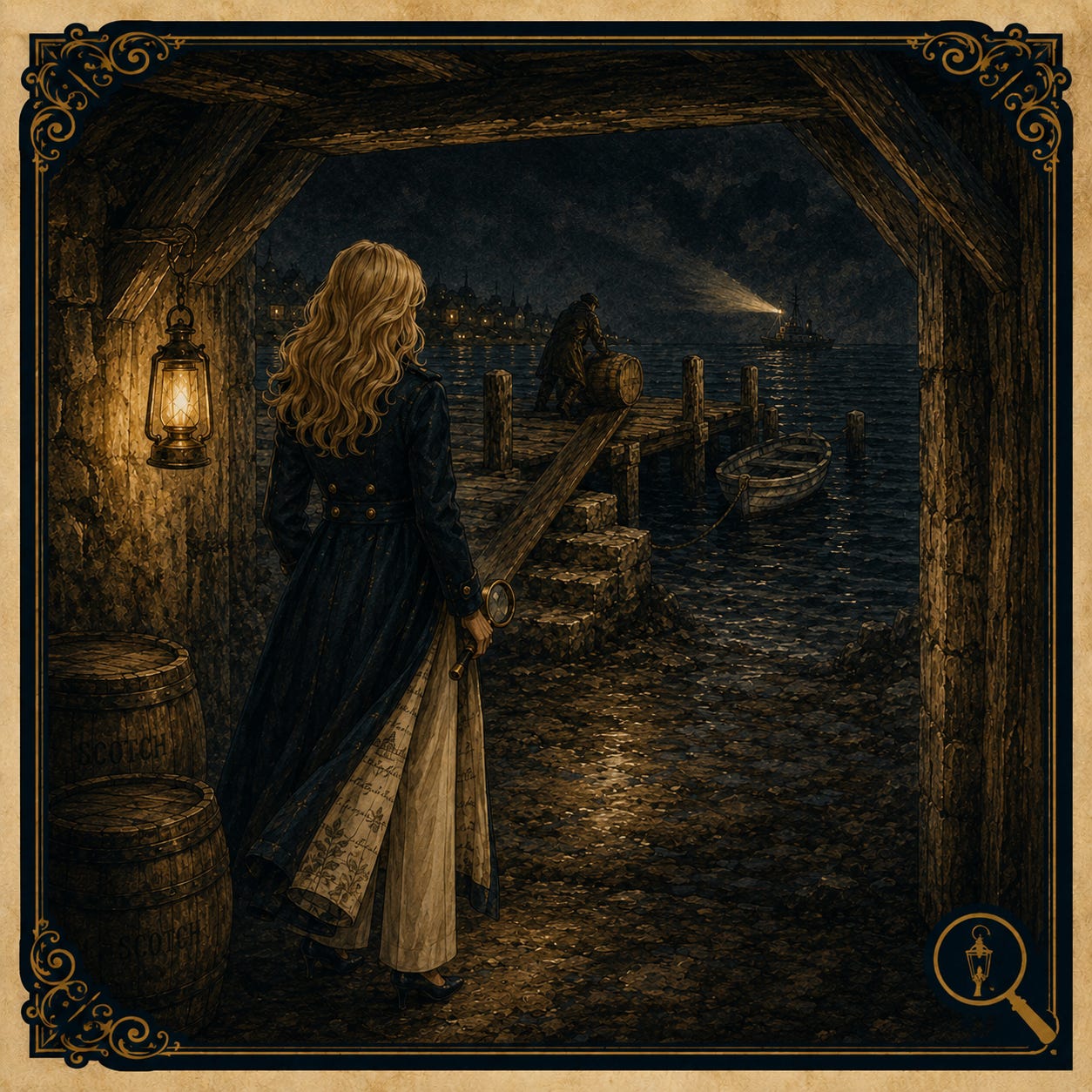
It was all part of an intricate bootlegging apparatus run by Philadelphia kingpin Max “Boo Hoo” Hoff — a former boxing promoter who earned his nickname from his remarkable ability to weep on command, an uncanny way to evade penalties in court.
Hoff ran a syndicate that treated Cape May’s coastline like his own personal loading dock, keeping the Coast Guard chasing phantoms while his men moved product into the city. Local fishermen moonlighted as his smugglers, taking advantage of hidden coves and unlit shorelines.
So when a woman’s voice calls a server’s name across a crowded dining room ninety years later, who is she really yelling at? A stranger carrying somebody else’s tray? Her own son? Or is she the wife of one of the fishermen-turned-bootleggers, giving him a scolding?
The Paranormal Expert
I would be remiss not to mention Craig McManus, the psychic medium who has spent two decades cataloging Cape May’s spirits across five books, and who arguably has a stronger claim on this town’s paranormal registry than anyone alive.
McManus devotes the opening chapter of The Ghosts of Cape May — New Haunts / Old Ghosts (2016) to Lucky Bones, detailing an investigation he conducted on a quiet night in February. Reading it now, having sat in that same dining room years later, what strikes me is not the specific spirits he identifies but the general character of what he found, which Jason echoed exactly.
Not menacing. Just territorial.
A presence that is not threatening but emits an unapologetic sense of ownership, as if the energy belongs to a group of people who have been there for a very long time and have every intention of continuing to run the place.
This is the ghosts’ local. They aren’t leaving. If anything, they’re still on the clock.
Emily Dickinson Said it Best
On the way back to the house, rain slammed the windshield. The radio played a single track that no one had selected. No one changed it. No one spoke. Each of us was lost in our own thoughts as the tenth movement of Kevin Puts’s song cycle Emily — No Prisoner Be filled the air.
It was haunting.
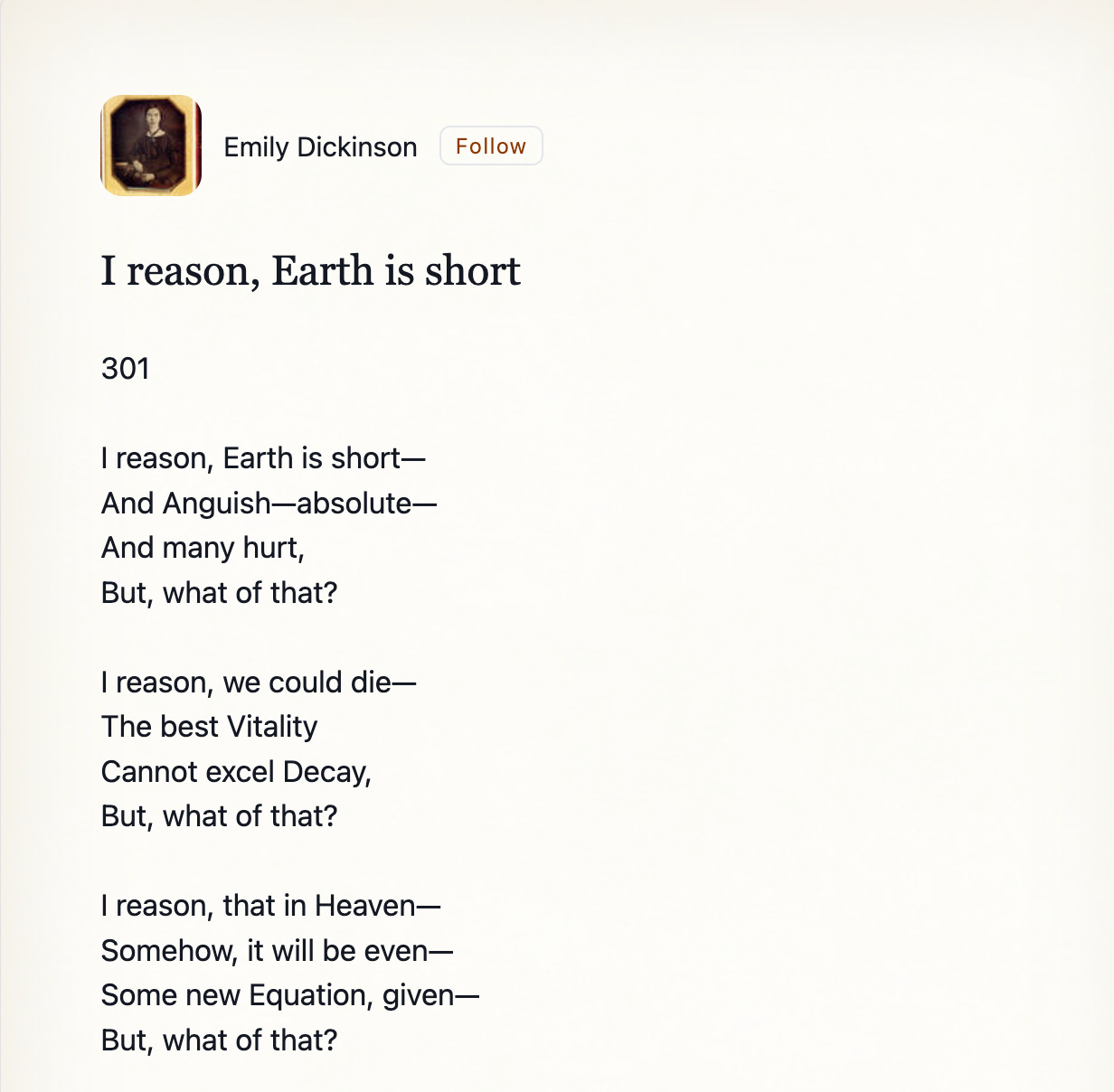
I looked it up this morning. It isn’t opera, exactly — Apple Music Classical files it as a song cycle that “defies categorization, traversing opera, musical theater, and rock.” Mezzo-soprano Joyce DiDonato floats over the string trio Time for Three, singing Emily Dickinson’s poem #301:
I reason, Earth is short —
And Anguish — absolute —
And many hurt,
But, what of that?
Dickinson’s poem lays out the three great inevitabilities. Life is short. No amount of vitality can defy decay, or last forever. But Heaven, if it exists, will somehow even things out.
Each stanza builds a case for existential despair, and each stanza dismisses it with the same refrain: But, what of that?
The poem is not a lament; it’s a shrug at eternity.
Whether a helpful spirit in the passenger seat thought the piece was fitting, or whether the universe simply has a strange sense of timing, it cemented my sense that all of us are ultimately just energy — connected by invisible threads stretching across time. In certain places, places like Cape May, you can spot the faintest trace of those threads, like glimpsing a moonlit spiderweb after the rain.
Life is short. The bootleggers and publicans who ran this bar are gone, but still, somehow, running it.
But, what of that?
Tonight
As of this morning, I have not heard back from Lucky Bones, though I am keeping my fingers crossed that I get a chance to learn about the tunnels, and to hear (and feel) what the building is like when the crowds thin out. I want to stand still on the second floor and let it hum at me.
Tonight the Full Buck Moon will illuminate the sky over Cape May — named for the season when young male deer grow out their antlers. The rain from last night has cleared the haze. The sky looks to be promisingly dark tonight, and who knows what spirits and stars we may see.
That hum is the whole thing. It is what I came to Cape May for in 2016, and it is what I keep coming back for. It is what family history really is, once you strip away the databases and the citations. It is the thing that has not entirely finished. It is the thing that has not quite left.
If I get to look in the tunnels, or pop in when it’s quiet, you’ll be the first to know.
More from the archives soon,
— Lulu
Sources & further reading
Primary documents
1915 New Jersey State Census, Camden — Wallace household (George Henry Wallace, blacksmith, age 31, Canadian-born; Nora, Irish-born; children including George Jr., age 6)
Camden Evening Courier, May 4, 1933 — “Marie Doran Bride In Wedding Today”
Cape May Star and Wave, June 4, 1942, p. 4 — Nora M. Wallace’s application for Plenary Retail Consumption License, in her own name
Cape May Star and Wave, November 19, 1942, p. 2 — Notice of application to transfer license from Nora Wallace to George Wallace Jr., trading as The Anchorage
1950 U.S. Federal Census, Cape May County, NJ — Wallace household, Schellenger’s Landing (three-generation household including three Georges)
Find a Grave memorial for George Henry Wallace (1882–1954), Saint Mary’s Catholic Cemetery, Cape May
The Sunday Gazette (Atlantic City), July 17, 1921 — front-page coverage of the Katz liquor arrests and Cape May Scotch seizure
Contemporary press
New York Times, “Rum Runners Busy Again: Atlantic City Authorities on Watch for Smugglers’ Ship,” July 14, 1921
Cape May County Herald, September 4, 1985, p. 49 — “Restaurants Run In Their Family”
Cape May Magazine — H.L. Williams, “Cape May As I Remember It: Part Five”
Local history
“From Rum to Subs: The Coast Guard in Cape May,” capemay.com
Cape May County Library, Virtual Digital Library System — digitized Cape May Star and Wave (1908–1943) and Cape May County Herald archives
Books and recordings
Craig McManus, The Ghosts of Cape May — New Haunts / Old Ghosts (2016), Chapter 1, “Lucky Bones: Where the Living and the Dead Meet for Drinks.” craigmcmanus.com
Kevin Puts, Emily — No Prisoner Be (2025), No. 10, “I reason, Earth is short” — Joyce DiDonato (mezzo-soprano) with Time for Three
Emily Dickinson, “I reason, Earth is short —” (poem #301)
Background
The Repeal of Prohibition, The Mob Museum — Twenty-First Amendment ratified December 5, 1933
Full Buck Moon 2026, Farmers’ Almanac — peak illumination July 29, 2026, 10:36 a.m. EDT
Lauren, your opening line, "What are family historians if not ghost hunters?", hooked me immediately because it captures something many of us struggle to put into words. What I enjoyed most was how you never asked the reader to believe in ghosts. Instead, you showed how places can hold memory, and how careful historical research can sit comfortably alongside mystery. By the end, I found myself less interested in whether Lucky Bones is haunted than in the generations of Wallaces whose lives became part of that building.
Your writing is very evocative. Wonderful piece.